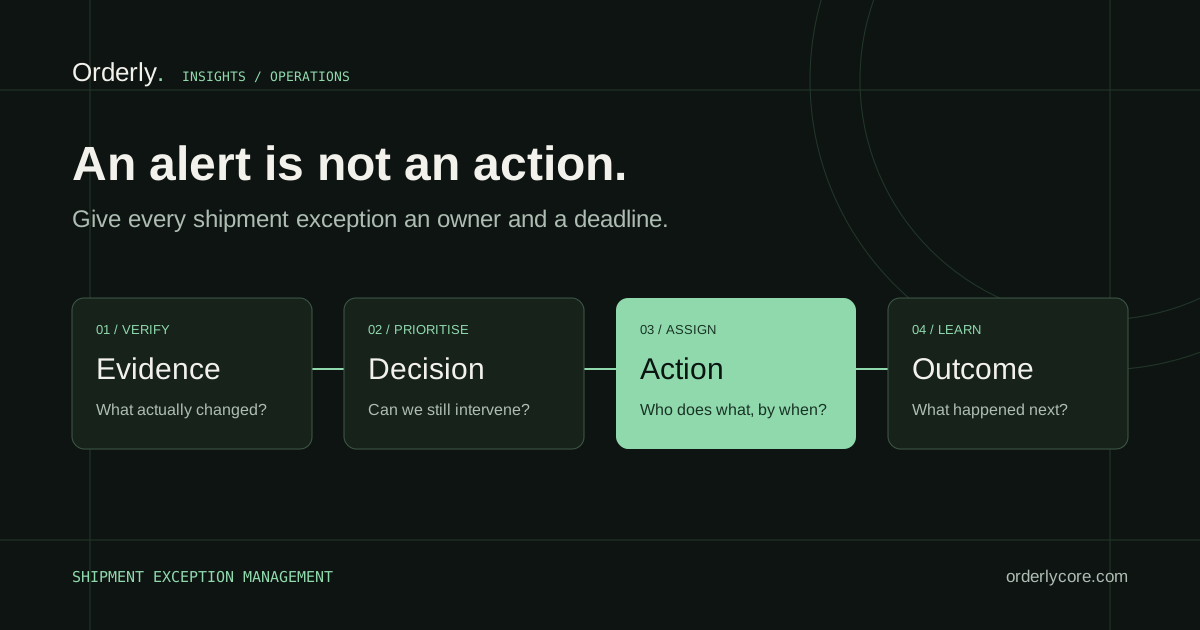
A tracking alert tells you something changed. Shipment exception management decides whether that change matters, who owns the response, and what can still be done before a delivery promise is missed.
For a fulfillment team, those are different jobs. A carrier can report a delay without knowing which customer needs an update. A warehouse can create a label without handing over the parcel. An operations dashboard can highlight both events and still leave someone to work out the next step.
The useful question is not “How many alerts did we generate?” It is “Which shipments need a decision while there is still time to change the outcome?”
What is shipment exception management?
Shipment exception management is the process of identifying, investigating, prioritising, and resolving problems that put a shipment’s expected progress or delivery commitment at risk.
It includes carrier-reported exceptions, but should not depend on them alone. Missing carrier acceptance, an unexpected route, a slipping delivery estimate, or a gap in tracking data may justify a review before a formal exception appears.
Not every unusual event means a parcel is late or lost. A useful process separates evidence of a physical problem from missing or delayed information, then chooses a proportionate response.
Tracking visibility is not the same as exception management
Tracking answers “What was the last reported event?” An exception workflow needs more context:
- What did we promise the customer?
- Has the carrier actually accepted the parcel?
- Is the latest scan fresh enough to support a decision?
- Is the shipment unusual for this carrier, service, and route?
- Who can intervene, and by what deadline?
A label-created event, for example, is evidence that shipping preparation happened. It is not proof of carrier possession. If the team treats those states as equivalent, an order waiting at the warehouse can appear to be moving through the network.
The opposite mistake is also possible: a parcel may be moving normally while scans arrive late. Escalating every quiet tracking record as “stuck” wastes attention and can create misleading customer messages.
Five exceptions worth separating
Different signals call for different checks. This is a starting framework, not a universal escalation policy.
| Signal | Check first | Possible next action |
|---|---|---|
| Label created, no acceptance | Warehouse handover evidence and the collection cutoff | Ask the warehouse to confirm handover; escalate a missed collection |
| No recent scan | Expected scan gaps for the route and tracking-feed freshness | Investigate the carrier movement or the data feed, depending on the evidence |
| Predicted delivery is slipping | The customer promise, prediction range, and latest events | Prepare a customer update and review recovery options |
| Unexpected facility or route | Route history and the carrier’s explanation | Ask the carrier to investigate a possible misroute |
| Carrier transit SLA is at risk | The applicable transit limit and remaining intervention window | Assign an operational owner and an act-by deadline |
Avoid one global “no scan for 12 hours” rule across every service. An overnight linehaul and a local delivery round have different expected patterns. A threshold is useful only if the team understands what it means in context.
Build a workflow from evidence to outcome
1. Put the evidence beside the shipment
Bring together the order, shipment identifier, carrier service, promised date, latest event, and time the event was received. Preserve the distinction between when something happened and when your system learned about it.
The operator should be able to see why the shipment needs attention without opening five systems. Include the uncertainty too: “No acceptance event received” is more defensible than “The carrier lost it.”
2. Prioritise the decision, not just the risk score
A high risk score is one input. The team also needs the customer impact, available recovery options, and time remaining to act.
Consider a hypothetical afternoon collection. One parcel has a concerning scan history but no useful intervention available until the carrier opens an investigation. Another has no acceptance evidence and can still make today’s collection if the warehouse acts now. The second may deserve the next call, even if its predicted delivery risk is lower.
Rank work around decisions people can still make. Keep purely informational alerts separate from cases that require action.
3. Give each exception an owner and a deadline
“Contact the carrier” is an intention. An actionable case says who will contact which carrier, what evidence they need, and when the result must be reviewed.
A minimum useful case record contains:
- The affected order and shipment.
- The reason for intervention and supporting evidence.
- The assigned person or team.
- The next action and act-by time.
- Any approval needed before changing the order.
- The decision, response, and eventual outcome.
Approval matters when an action creates cost or changes a customer commitment. A replacement shipment, service upgrade, or cancellation should follow the operation’s policy rather than happen automatically because an alert fired.
4. Communicate what you know
Customer updates should distinguish facts from estimates. Explain what has changed, what the team is doing, and when the customer will hear again.
If a delivery window is uncertain, do not turn it into a precise promise. If carrier acceptance is unconfirmed, do not describe the parcel as lost. Better internal evidence should make the external message clearer, not more confident than the evidence allows.
5. Close the loop with the real outcome
Do not close a case merely because someone sent a message. Record whether the carrier accepted the parcel, the route corrected, the customer received an update, or the shipment ultimately missed its commitment.
Review false alarms as well as useful alerts. If a recurring signal generates work but rarely leads to a meaningful decision, change the threshold or the workflow.
Keep delivery promises and transit SLAs separate
Two shipments can be “at risk” for different reasons. One may be likely to miss the date promised to the customer. Another may exceed the carrier’s transit-time SLA while still arriving within the customer promise.
Those are separate measures. Combining them into a single unexplained red status makes it harder to choose the right response. Customer communication and carrier escalation may have different owners, evidence requirements, and deadlines.
Orderly’s predictions and risk documentation explains this distinction in the product. Predicted late delivery and predicted transit-SLA breach answer different operational questions.
Where Orderly fits
Orderly Hub manages the operational record across orders, routing, release, and shipment activity. Orderly Intelligence adds delivery predictions and signals that help the team identify what may need attention.
The Alerts view surfaces reasons and recommended next steps. The Intervention Queue focuses on in-transit SLA risk and act-by deadlines. Before carrier acceptance, fulfillment operations require a different set of checks around handover evidence and cutoffs.
These are tools for supporting a decision, not a guarantee that every delay can be prevented. For the underlying design, read how we built Orderly’s fulfillment architecture.
Measure the work, not the number of alerts
Start with a few clearly defined measures: time from detection to ownership, the share of actionable cases reviewed before their deadline, false-alarm rate, and final delivery outcomes. Review them by carrier, service, and route where the sample is large enough to be useful.
Avoid claiming that every on-time delivery after an intervention was “saved.” Some shipments would have arrived on time anyway. Record the action and the result without confusing sequence with proof of causation.
The aim is a smaller, more useful queue: fewer unexplained red dots, clearer ownership, and better decisions while they still matter.
Common questions
Does a shipment exception mean the parcel is lost?
No. An exception can mean a temporary delay, an address issue, a routing problem, missing acceptance evidence, or another interruption. Check the carrier’s event and the shipment context before choosing a response.
When should a team act on a missing scan?
When the gap is unusual for that carrier, service, and stage of the journey, or when a handover or customer commitment is approaching. Check data freshness first; a universal time threshold cannot explain every shipment.
Can shipment exception management be automated?
Evidence gathering, case creation, and routine notifications can be automated where the connected systems support them. Keep approval requirements for costly, irreversible, or customer-sensitive actions. Automation should make ownership clearer, not remove it.
Put it into practice
Connect the signal to the work.
Explore how Orderly Hub and Orderly Intelligence fit your fulfillment operation.
Talk to Orderly ↗