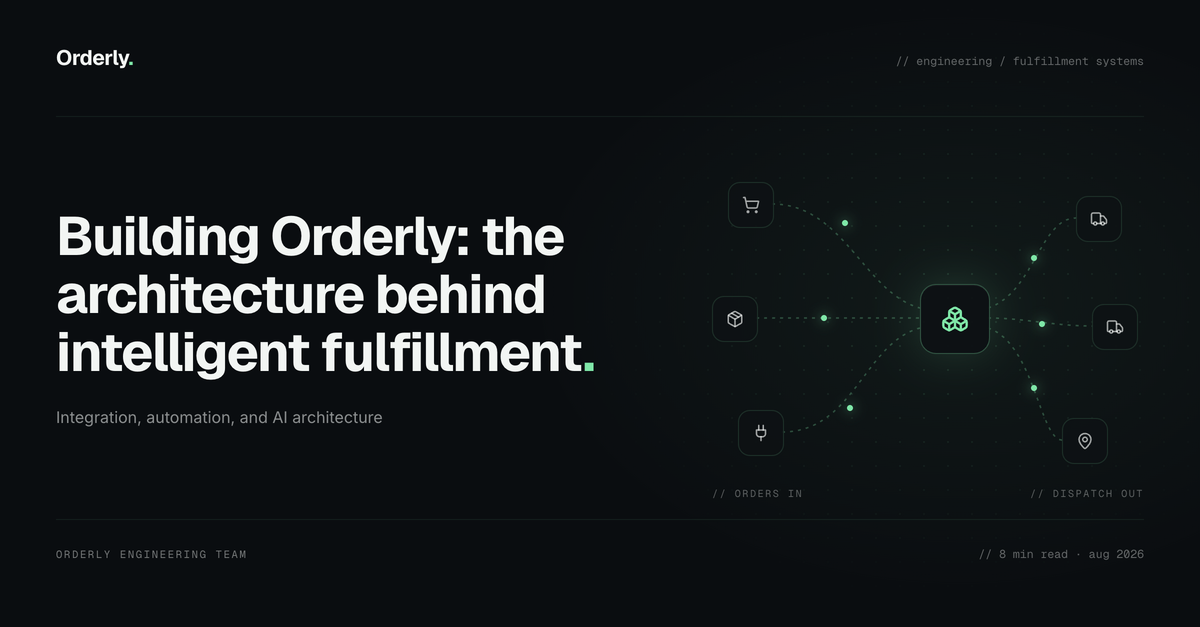
Orderly started with a simple observation. Fulfillment teams use several systems to move one order, yet no single system gives them a reliable view of the whole process.
We built Orderly to provide that view and to run the work between those systems. The result is an operating layer for orders, inventory, fulfillment, shipping, and the decisions that connect them.
The problem
An order begins in a commerce platform. It may then pass through an inventory system, a warehouse, a shipping platform, a carrier, and an ERP. Each system records the part it owns, using its own identifiers and statuses. The people running the operation are left to piece those records together.
That becomes difficult as volume grows. A routing rule may send an order to the wrong warehouse. Stock can change before release. A label can exist even though the parcel has not shipped. A failed request may be retried after the receiving system already accepted it. Split orders make the picture harder because one purchase becomes several fulfillment jobs.
Most integration software concentrates on moving data between two endpoints. The operational questions remain with the team. They still need to know which version is correct, whether an action is safe to repeat, and what should happen next.
How we arrived at a solution
The first requirement was a shared order model. Orders from commerce platforms, APIs, ERPs, and EDI connections had to enter the same structure while retaining a clear link to their source. Once that existed, routing and automation could work consistently across every connected system.
The next requirement was a clear lifecycle. Assignment, release, label creation, shipment, and delivery are separate stages. Keeping them separate gives the operator an accurate answer and gives automation a safe place to resume after a delay or failure.
Release became the main control point. An order can be assigned to a destination without being sent immediately. The organization's policy decides when it leaves, whether stock should be reserved, and whether a person needs to approve it. This supports highly automated operations as well as teams that need tighter manual control.
Fulfillment also spends a lot of time waiting. Workflow tools hold the state while an order waits for stock, a release window, a warehouse, or a carrier update. Background workers resume the job when there is something to do. The database keeps the current state and its history, with organization-level controls around customer data.
What we built
Orderly Hub connects commerce, warehouse, shipping, carrier, ERP, EDI, and custom systems through one integration layer. Incoming orders are normalized, transformed when needed, split when required, assigned to a destination, and released according to the organization's rules.
Dispatch Lane covers the work before a parcel leaves. Teams can compare services, assign shipping, purchase labels, and produce packing documents from the same order record. Operations that use an external warehouse can release orders through a connected bridge instead.
The portal brings the order, its source, routing decisions, release state, shipments, and activity history into one view. Operators can see where work stopped and retry or correct it from the same place. Manual controls remain available when the real operation does something the original rule did not anticipate.
Orderly Intelligence adds a decision layer. It uses shipment and tracking outcomes to estimate delivery windows, identify late risk, and surface orders that may need attention. A person can review recommended actions before they change an order.
Where we plan to go
The next stage is broader coverage and tighter coordination. More commerce, warehouse, ERP, and EDI connections will reduce the amount of custom point-to-point integration that teams have to maintain.
Operational work will continue to focus on reliability, clearer exceptions, and safer bulk automation. Intelligence will move closer to the daily fulfillment flow by identifying problems earlier and presenting the evidence behind each recommendation.
Hub runs the operation and keeps its history. Intelligence studies what happened and helps the team decide what to do next. Both are built around the same order and shipment record so the recommendation stays connected to the work.
Turn tracking alerts into operational decisions
Read our practical guide to evidence, ownership, and act-by deadlines.
Shipment Exception Management: From Tracking Alerts to Action →